First Frost.  A desire to finish a quilt top that her Grandmother had left unfinished is what got Jan Hutchison started in quilting over 17 years ago. Jan still hasn’t finished her grandmother’s top, but she did catch the quilting bug and hopes to one day honor her grandmother by finishing it one day.
 First Frost was inspired by the work of William Morris. Jan decided to make it a whole-cloth quilt. It took her approximately four months to make her Best Longarm Machine Quilt, from drawing out the design to the very last stitch.
The fabric she chose was a linen with a metallic glaze which Jan thought would really show off the quilting. (And it did!!) While it is beautiful fabric, Jan discovered along the way that it created several problems. For one, on show quilts, Jan said that she typically knots and buries her thread tails, ending up with hundreds of them in each quilt she makes. Because the linen had a looser weave than the usual quilting cottons, Jan found it was harder to make a knot big enough to stay buried in the quilt sandwich. Another issue she came across had to do with the metallic glaze. It actually weights the fabric down and holds fold lines more than Jan liked. In spite of those challenges, Jan still loved the overall effect that the glaze gave the quilt.
 How did Jan react when she found out she had won Best Longarm Machine Quilt? She had her eye on her email the day she knew that Road to California would be notifying the winners. Jan was “elated” to receive her notification.
What did Jan do with the $2,500 in prize money she received for Best Longarm Machine Quilt? She said she was going to “pay some bills” and probably put some of it towards “new fabric or thread.”
Don’t be surprised if another one of Jan’s quilts are entered in Road’s 2019 Quilt Contest. She has another whole-cloth quilt in the works and hopes that it will be finished by the October 2, 2018 deadline.]]>
Welcome to the Road to California Blog
Best Longarm Machine Quilt At Road 2018
September 27th, 2018Teaching The Art Of Handwork Quilting Techniques
September 25th, 2018 On Wednesday: 3007C – For Anne
On Thursday: 4009C – Millefiori, La Passacagila
On Friday: 5006C – Tule Nova English Paper Piecing Quilt
 Diane Kirkhart was a “dabbler” in sewing and crafts before she found the handwork quilting bug. She tried knitting, crochet, cross stitch, bobbin lace and ceramics. She even did some painting for a while teaching friends and friends of friends. One afternoon during one of those classes, there were several quilters enrolled. They asked if Diane would be interested in attending a quilt meeting that evening. As she recalls, “Of course I went and as they say, the rest is history.”
 What does Diane like most about handwork quilting techniques? “My favorite aspect would be working with colors and seeing a quilt come to life whether from a pattern, a picture or sometimes even from my head.” And her least favorite aspect of quilting? Binding. “I know I should be happy to do it but two things, this journey is over and my hands usually ache afterwards!”
Handwork quilting, especially appliqué, has been Diane’s favorite from the start, due to that first quilt guild meeting she went to. A member of that guild, Emily Martin, was giving a trunk show and Diane loved each quilt presented. She decided then and there that this was what she wanted to do and began her journey. Diane eventually took a class from Emily and so appreciated that class. Diane learned a lot of things including the fact that to this day, she doesn’t like using the freezer paper technique. Instead, Diane has adapted over the years combining several appliqué techniques and is “still adapting, still learning.”
Where does Diane do her handwork quilting creating? She says she is fortunate to have a fairly large bedroom in her Virginia home to use as her sewing space.
 “It has a walk in closet and an attached bathroom which is very convenient. As I said it is quite large but the more you have, the more you want. Two walls are lined with Elfa drawers from the container store, of course filled with fabric and notions. On top of several of them, I have placed my big board ironing surface. There is a big easy chair and footstool in the corner. I have an old drafting table elevated with bed risers for a cutting table. Beneath that table are two bookcases from Ikea or someplace like that where I keep my books, light box and other paper type supplies. Various rulers (her favorite are Quilters Select rulers) are on a smaller drawer set and others are hanging on the wall.
 Around the walls, I have a Bernina-Q20 and I keep it’s table closed to its smaller size until I need to put its leaves in it when I use it for quilting. In the center of the room I have a Horn Table with my Bernina 440 in it. My sewing chair sets in between both machines. There is a tv on the wall but it’s rarely on. I like the peace most days.
 Oh, I also have a computer in there. It’s tight in there, but it works for me. And if a friend comes to sew, I can flip up the drop leaf of my Horn Table or if they bring their Sew Easy Table there is room.”
A handwork quilting teacher for over 14 years, Diane loves when she can evoke excitement and see a light bulb come on in a student’s face. Diane also loves to listen to the chatter and banter of her students, especially when one student is explaining to another what Linda had just said, but in a different way. Linda has observed, “Not everyone learns the same way and sometimes their description works better. I too get to learn!”
What does Diane want for her Road to California students? “I hope they gain the skills to complete the project. I want them to be confident that they can continue and even expand and someday share what they have learned by teaching someone else to keep this quilting party going.”
To learn more about Diane, please visit her website.]]>
A Vendor With A French Accent
September 21st, 2018 French General, an online company and vintage craft workshop started by sisters Kaari and Molly Meng over 20 years ago in New York?
The Beginning of French General
Before there was French General, Kaari was a jewelry designer specializing in unique designs made from vintage glass beads, buttons and notions. Her work was first shown at Bergdorf Goodman in New York in the early 1990’s. Later, when retailer Anthropologie started in Philadelphia in 1992, Kaari’s work was featured by them. For several years, Kaari enjoyed designing for retail shops, museums and catalogs with all her jewelry pieces utilizing her vast collection of antique beads found all over the world. Kaari brought Molly on to help manage the business. When Kaari’s daughter was born in 1997, Molly and Kaari were burnt out with the jewelry business and retired. Wanting to share their passion for everything French, they opened a workshop in an old barn in their backyard and began French General as it’s known today: French-inspired lifestyle items including textiles, notions, ephemera, and household items found only in France. Their first French General retail store was located in SoHo. When Kaari and her family moved to California in 2003, French General’s headquarters were relocated to an old Spanish style warehouse on the edge of Los Angeles. Only open for one day a week, customers come in and browse French General’s ever-changing collections that Kaari and Molly find on yearly trips to the South of France.
What does French General Specialize in?
In addition to offering vintage craft kits, jewelry, embroidery floss, French General self-designed quilting fabric and patterns, and their own brand of scissors on their website, French General also teaches craft workshops on jewelry making, stitching, paper crafts, sewing, shibori, indigo dyeing, and weaving using their vintage craft materials. French General has expanded from Kaari and Molly as the only teachers to now including other talented teachers from around the world who visit to share their techniques and inspiration.
One of their most popular (and exclusive!) items that they sell is their brass ring embroidery hoop.
 Available in three sizes, its French design incorporates a steal coil wire that fits in the rim channel, providing excellent tautness for any embroidery project. It can also be used with sewing machines by simply raising the pressure foot and inserting the hoop on the brass side.
 Every summer, French General sponsors a women’s trip to the South of France. The trips run for one week at a time during the month of June and sell out quickly. As their employee, Cathy Mogull explains, “It is a summer camp for grown women to experience French food, crafting, and treasure hunting.”
Road to California 2018 was French General’s first time at the show.
 Not only did they feature their online products in their booth, but they also offered several of their crafting workshops. Kaari commented that Road “was a fun show.” They saw many of their customers and made new friends. Road had “been good for us.”
[caption id="attachment_6071" align="aligncenter" width="625"]
 Cathy, Molly and Kaari of French General[/caption]
Road to California 2019 looks forward to having French General return and again share its French accent with our guests.]]>
Meet Road 2019 Teacher Wendy Sheppard
September 18th, 2018FIVE dynamic quilt classes, first focusing on applique techniques and quilting on a domestic sewing machine then spending the rest of the week on free motion quilting skills utilizing longarm and domestic machines:
Monday and Tuesday: 1202C A Reprise: Baltimore Quilt Block
Wednesday: 3015C Rhyme and Reason from Simple to Complex
Thursday: 4019C De-mystifying Feather Quilting
Friday: 5016C Roundabout Feather Quilting: A Sampler
Saturday: 6016C Ideas- What to Quilt?
 Today, she enjoys all aspects of the quilting process. Her quilting space is a main-level office in her home located in northern Virginia, about 45 minutes from Mount Vernon, the estate of George Washington. Maybe that’s why if Wendy Sheppard isn’t quilting, she is pursuing her interest in Early American History.
What quilter has had an impact on Wendy and her quilting journey? “I always admire Diane Gaudynski. She is my hero! She inspires me to strive for more than adequate, but rather strive to be excellent in constructing and quilting my quilts.”
Wendy Sheppard has been teaching quilting classes on and off for about 9 years. She first taught at a local sewing center. She stopped when her daughter was really young. During those years, Wendy filmed online/video classes for Annie’s on domestic machine quilting.
What does Wendy like most about teaching quilt classes? “…The smiles on the faces when my students realize they CAN accomplish certain skill sets taught in class.” She hopes her students at Road “will gain confidence in the techniques I will be teaching in my classes. I also hope that my students will make friends with the fellow attendees while we are working on projects in class.”
Sewing machines will be provided for all of Wendy’s classes. Husqvarna-Viking machines will be available for students in her Monday/Tuesday class. The rest of Wendy’s classes will feature half BERNINA Q20 sit down longarm machines and half BERNINA domestic machines. Students will split their time working on both machines.
Join Wendy to learn expert free motion quilting techniques while trying out quality Bernina sewing machines.]]>
Meet The Citrus Belt Quilt Guild
September 13th, 2018 Citrus Belt Quilt Guild located in Redlands, California, boasts a membership of 200 members, 12 years and older. The quilt guild meets the last Friday of the month during the day and also sponsor a Moonlighters evening group, which meets the third Thursday of the month. The Citrus Belt Quilt Guild participates with 15 different charities including Santa Claus, Inc., The Ronald McDonald House in nearby Loma Linda, and The Painted Turtle Camp, a year-round, life-changing environment, started by Paul Newman, for children with life-threatening diseases and their families that allows children to participate in an authentic camp experience by supporting their medical needs and offers their families care, education, and respite.
The quilt guild regularly makes Turtle Pillows for the Painted Turtle Camp, as well as pillowcases, Alzheimer’s Fidget Quilts, Pet Beds, Tote Bags for walkers, and wheelchair quilts to support their charities.
The guild was on hand at Road to California 2018 to share their popular Quilt Guild Opportunity Quilt, Autumn Amour.
 Member Robin Grube designed and organized the construction of the quilt along with two other guild members. One floral fabric was chosen to cut into 6 strips and many sets of equilateral triangles were cut from the layers. Fifty members created fifty kaliedocopic hexagons. The shapes were then placed on top of a panel depicting a Parisian scene. Free motion quilting was done in multi-color threads on a domestic swing machine. It took the guild 3 months to complete.
[caption id="attachment_6052" align="aligncenter" width="710"]
 Autumn Amour[/caption]
Tickets for the quilt are still being sold for $1.00 each. The winning ticket will be drawn on October 26, 2018. To purchase tickets, please contact the guild.
Does your guild have an Opportunity Quilt you want to showcase at Road to California? Limited tables are available each day of the show. If interested, please contact Road at info@roadtocalifornia.com.]]>
Meet Road 2019 Teacher Mel Beach
September 7th, 2018 3001C Magnificent Mandalas
4002C Slice of Improv
5002C Mod Molas & Bright Blooms
6002C Mod Mandalas
 Mel’s favorite part about quilting is to pull fabrics together for a new project and come up with a fun design. She also loves transforming her quilt tops with beautiful, modern quilting designs.
The least favorite part of making a quilt for Mel is when the quilt isn’t speaking to her, usually when she’s trying to figure out a layout and/or determine the quilting. Using a design wall helps her explore different layouts and compositions. A sheet of acrylic plastic and some dry erase markers also come in handy for auditioning different quilting motifs.
Where does Mel do her quilting? Her studio occupies her formal living room. Her partner is super handy and helped her to transform the room into a fabulous space for her to design and quilt. He converted an IKEA table into a sewing table by carving out a hole and setting Mel’s machine into a set-in shelf so that she had a large flat space for quilting. Her partner also built a custom wall unit to store all of Mel’s rulers and notions, as well as large benches that store batting, travel gear and make for great seating for Mel’s two pups to look out the window.
 The two quilting tools that are always close are Mel’s camera to help her document her quilt making process and aide with design decisions and a trusty roll of blue painter’s tape which is super handy for accurate cutting, labeling blocks, mark-free quilting lines, and so much more!
When Mel isn’t quilting, she loves going for walks with her two rescue pups, Panda & Susie Q, and taking pictures along the way. For the past 2 years, she has been taking Comedy Improv classes and routinely performs in comedy improv shows (similar to Whose Line Is It Anyway). Mel shares, “Not only have these classes helped me be more comfortable with public speaking and teaching, they also help me to think quickly on my feet, explore new possibilities, and they are so much fun!!!”
Mel started teaching quilt making classes in 2015 when she was asked to lead a quilting demo for her guild. Mel said, “It was such a positive experience all around with lots of happy finishes. Less than a year later, I started to promote myself to other guilds and soon joined the quilt teaching circuit.” Mel’s favorite part about teaching classes is that she loves “watching the transformation among participants as they learn new techniques. Some may come in feeling initially nervous yet leave feeling confident and excited about learning a new technique. I also really enjoy watching quilters add their own fun twists to the technique and make it their very own!”
[caption id="attachment_6042" align="aligncenter" width="452"]
 Maker:L,Date:2017-9-30,Ver:5,Lens:Kan03,Act:Kan02,E-Y[/caption]
What goals does Mel have for her Road students? There are four:
- Have fun!
- Try something new and different!
- Be inspired!
- Make it your own!
So You Want To Make A Winning Quilt? Best Domestic Machine Quilting Road 2018
September 5th, 2018 Susan E. Stewart received $2,500 for Gilded Roses from Sponsor Baby Lock
When you ask Susan Stewart how long she has been sewing, her reply is, “All my life.”
Susan spent many years doing heirloom sewing for a company in Alabama. She started her quilting path in 2004 and won a blue ribbon at Quilt Festival in Houston for her very first quilt. No wonder she exclaimed, “I was hooked!” Gilded Roses was inspired by the lacy, watercolor-y rose machine embroidery design from Urban Threads. Susan said she could picture the roses done in a rainbow of different shades, adding a touch of variety to an all-white and gold quilt. She added some lacy, scroll-y gold swirl designs from OESD to pick up on the lacy designs in the rose motifs and then added some large lace designs. The lace designs are John Deer Adorable Designs are stitched on the fabric and are also done as free-standing work along the edges. The quilting was done to add interest and to highlight the embroidery. It took Susan 2½ months to complete Gilded Roses, “the shortest time ever to finish a quilt!” She said that she had just finished another quilt and guessed that she “was on a roll!” What was Susan’s biggest takeaway from making Gilded Roses? “I learned that it is very time-consuming to stitch the binding on entirely by hand!” Susan said she had forgotten that she had entered Gilded Roses in Road’s 2018 quilt contest. When she received the notice that she had won, she was at home, recovering from some physical issues. Susan was thrilled and delighted to win Best Domestic Machine Quilting for Gilded Roses and exclaimed, “Woohoo! $2500!” What was Susan going to do with her prize money? “Honestly, it will go toward bills.” Susan isn’t sure what the next step will be in her quilting adventure. “I don’t know. Recent events have thrown a big curve ball at me, and I don’t know where I’ll land. If I can continue making contest quilts, I will. If I can’t, then I’ll re-invent myself! Where will you see me next? Who knows!” Congratulations Susan for winning Best Domestic Machine Quilting for Gilded Roses and best wishes for your future endeavors.]]>Road's State Of Art Quilt Contest
August 30th, 2018 $92,000 in prize money. Road’s Best of Show winners from our quilt contest are consistently shown in other national and international shows.
[caption id="attachment_5489" align="aligncenter" width="625"] 2018 Best of Show, “Fractal,” by Claudia Pfeil[/caption]
Are you considering entering your quilt in our 2019 quilt contest? We are accepting entries through October 2, 2018. All upcoming entries must include the official entry form, two pictures (full view and close up) as well as the entry fee of $30. The entry fee is discounted $10 if the entry is submitted online.
Road’s new and updated enrollment system not only includes an area to enter your quilt information, but it also allows the entrant to submit return shipping information themselves, so as to not have to rely on Road Staff to enter and/or change shipping directions. Return information is also automatically verified with FedEx to ensure all quilts are directed to the proper destination.
Categories for submitted quilts to Road’s quilt contest have recently changed. The new categories include:
- Abstract – Quilts entered in this category should reflect principles of abstract design. Forms and compositions should emphasize color, line and design. Quilts should be abstract, cutting edge and non-literal.
[caption id="attachment_6030" align="aligncenter" width="640"]
 2018 Best Abstract by Lou Ann Smith[/caption]
- Animal – Quilts entered in this category should feature an animal or creature as the centerpiece of the quilt. Can include other sub-design elements, but the animal or creature must be the primary focus of the quilt.
- Fantasy – Quilts entered in this category should feature non-realistic animals, insects, people, places or things. Fairytale and cartoon type quilts belong in this category.
- Human Image – Quilts entered in this category should feature some recognizable aspect of the human form.
- Naturescape – Quilts entered in this category should illustrate an aspect of a natural scenery. Creatures and animals may be a component, but should not be the focus of the quilt.
- Pictorial – Quilts entered in this category should illustrate a recognizable image (Cityscape, Wildlife). Use this category if your quilt combines aspects of the other categories listed above.
- Miniature – Quilts entered in this category should have overall patterns that show reduced size and miniaturization. Miniature wholecloth quilts should be entered into this category. Quilts entered into this category must not meet the descriptions of Categories 1-6.
- Appliqué – Quilts entered in this category should reflect traditional principles but may deviate from tradition. The quilt should be composed at least 50% of appliqué, in any technique (fused, machine, hand, etc.)
[caption id="attachment_6000" align="aligncenter" width="575"]
 2018 Best Applique by Katy Wylie[/caption]
- Pieced – Quilts entered in this category should reflect traditional principles but may deviate from tradition. The quilt should be constructed by piecing, either hand or machine.
[caption id="attachment_5949" align="aligncenter" width="640"]
 2018 Best Piecing by Catherine Butterworth[/caption]
- Mixed – Quilts entered in this category should reflect traditional principles, but may deviate from tradition. Enter your quilt in this category if the predominate construction method is a mix of both piecing and appliqué.
- Other – Quilts in this category should reflect traditional principles but may deviate from tradition. Enter your quilt in this category if it includes one or more of the following construction techniques: whole cloth, crazy quilts, embroidery and fabric manipulation.
A Winner With A Big Heart
August 15th, 2018At this year’s Road to California, more than 250 contestants competed for over $36,000 in cash awards. We’ve introduced you to the “big” winners and shared with you their thoughts on winning $5,000 for Best of Show, $3,000 for Masterpiece, and $1,500 for the Director’s Award prizes.
Not long after the show, we received a charming thank you note from another winner, Rachel Wetzler, who won two of the other prizes that were offered this year. Rachel received $250 for first place in the Traditional Wall Applique category.
She also received $50 for her third place finish in the Innovative Wall Mixed category. 
Seven Photo Tips For Quilters
August 14th, 2018 Gregory Case was Road’s Official Photographer for 4 years. He often got requests for advice from quilt/textile/fiber artists who were trying to improve their photography of their design work. Gregory offered seven suggestions for photographing quilts:
1) Prepare for your photo shoot. Professional quilt photography is a combination of your quilt hung properly, a good digital camera, appropriate camera settings (including “white balance/color” settings), use of a tripod, even and consistent lighting, and the use of image-editing software. If you are not using all of these techniques, you are not helping your quilt photography succeed.
2) Allow the time necessary to take a great picture. More people will probably see the photograph of your quilt than they will see your quilt in person. Thus, take the same care you do with your photography as you do with your quilt design and choice of quilter. Plan at least an hour (or more realistically, two hours) per quilt for photography/image-editing.
Katie Pasquini Masopust
3) Photograph the “whole” quilt. The top four quilt photography problems are getting the color right, properly lighting your quilt, showing surface texture, and highlighting the details better. Take the time to learn how to be good at all four of these photography techniques.4) The picture representing your work should be the best picture. More quilts are rejected from juried shows/magazines/books due to poor photography than any other reason! Remember, there is no asterisk (*) on your pattern, or on the juried show application, or the book proposal, for photo explanations like: “If it weren’t so sunny…,” If the wind wasn’t blowing so hard…,” “Please ignore my fingers and feet in the photo….,” “If only I had more time to take a better photo…,” or “If I could just get the color right… ,” etc. The buying public, the quilt judges, and the magazine and book editors all assume that the quilt image you present to them is an accurate portrait of your quilt, shown in its best light. Your quilt image is being compared to other’s images who have taken the time to make their image perfect. Make sure that your image lives up to their expectations!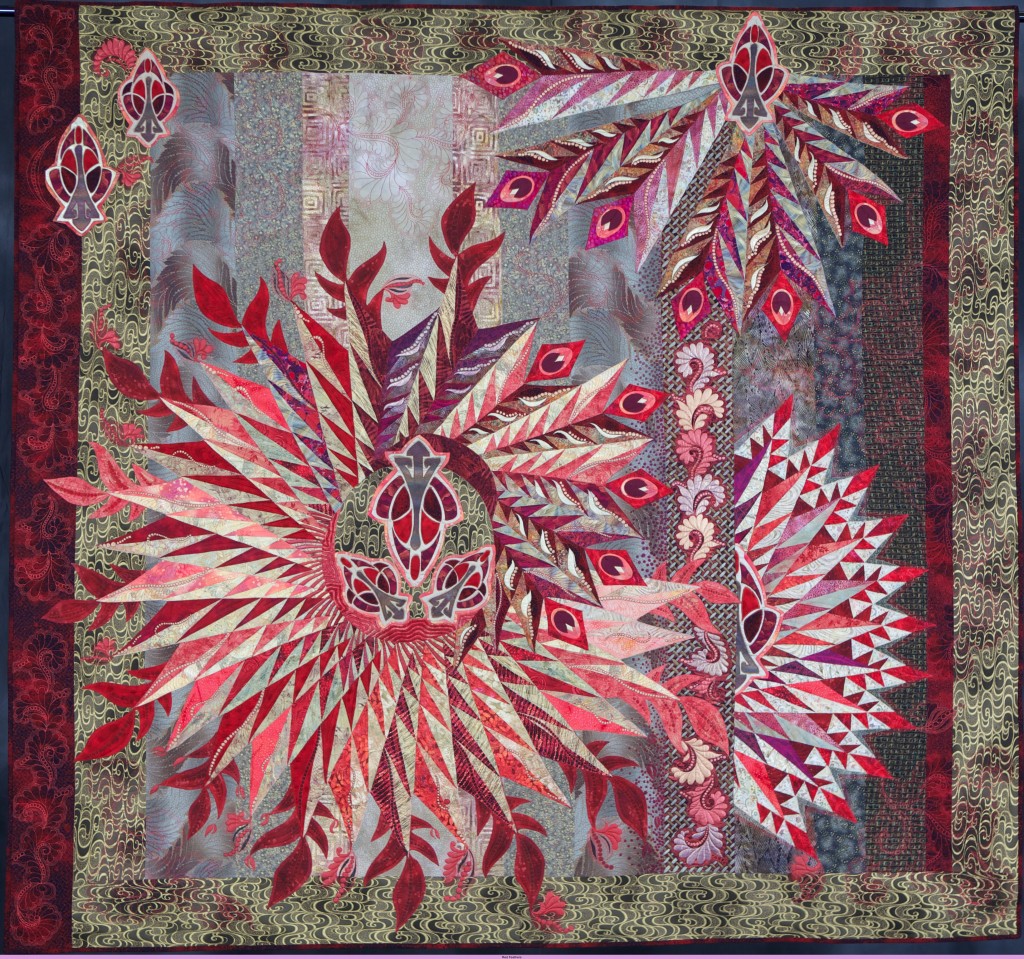
Best of Show 2013
5) Use available tools to edit your work. If you shoot with a digital camera, you really need to learn image-editing software (e.g., Adobe Photoshop Elements, Photoshop, and Lightroom). Some problems can only be solved with your digital camera and lighting, and some problems can only be solved with image-editing software—you need to employ both strategies.6) Practice. Practice. Practice. So, how do you get to be a better quilt photographer? Practice—a lot. Don’t wait until a deadline to start improving your quilt photography. Start practicing today and then again tomorrow and so on. I’ve been photographing quilts, textiles, and fiber art for 11 years and I work daily on improving my photography and image-editing skills. Take a quilt photography class, perhaps on the upcoming Road to California Quilt Cruise Around The Panama Canal. I will be teaching quilt photography and Photoshop Elements!